
If your drains are gurgling, you are catching a sewage smell indoors, or you see wet ground near your drain field, this is not a wait-and-see situation. Call Centrel Services at (321) 363-1995 right now for same-day septic tank pumping in Kissimmee. The faster you act, the more you protect your drain field and keep sewage out of your house.
Kissimmee homeowners on septic systems know that the system is easy to ignore until something goes wrong, and when something goes wrong on a Friday afternoon or a Saturday morning, it goes wrong hard. What starts as a slow drain or a faint outdoor odor can escalate to a full backup inside the house in a matter of hours if the tank is at capacity and the drain field is already saturated. The good news is that most of those situations are recoverable with a same-day pump-out if you call before the system reaches its limit. Here is how to read the signs and what to do about them.
What Warning Signs Mean You Should Call Now Instead of Waiting?
Some septic symptoms are routine. Others mean the tank is close to overflowing and the drain field is about to take the hit. Knowing the difference between a slow drain caused by a partial clog and a slow drain caused by a full septic tank is the first thing to sort out, because the fix is different and the urgency is very different.
Call for emergency service if multiple drains in the house are draining slowly at the same time. A single slow drain is usually a localized clog. Multiple slow drains happening together, especially toilets, sinks, and showers all backing up simultaneously, indicates that the system downstream of the house is not accepting flow. That means the tank is full, the drain field is saturated, or both. Add a sulfur or sewage odor inside the house or near floor drains to that picture and the tank is almost certainly at or past capacity.
Outside signs are equally serious. Wet or spongy ground over the drain field area, standing water in the yard that does not correspond to recent rain, or unusually green and lush grass directly over the drain field lines are all indicators that effluent is surfacing rather than percolating into the soil as it should. In Osceola County's clay-heavy soils, that saturation can develop faster than homeowners expect, particularly after a wet season. If you are seeing any combination of indoor backup symptoms and outdoor wetness near the drain field, that combination calls for same-day service rather than a scheduled appointment next week.
What Does a Pump-Out Actually Involve and How Long Does It Take?
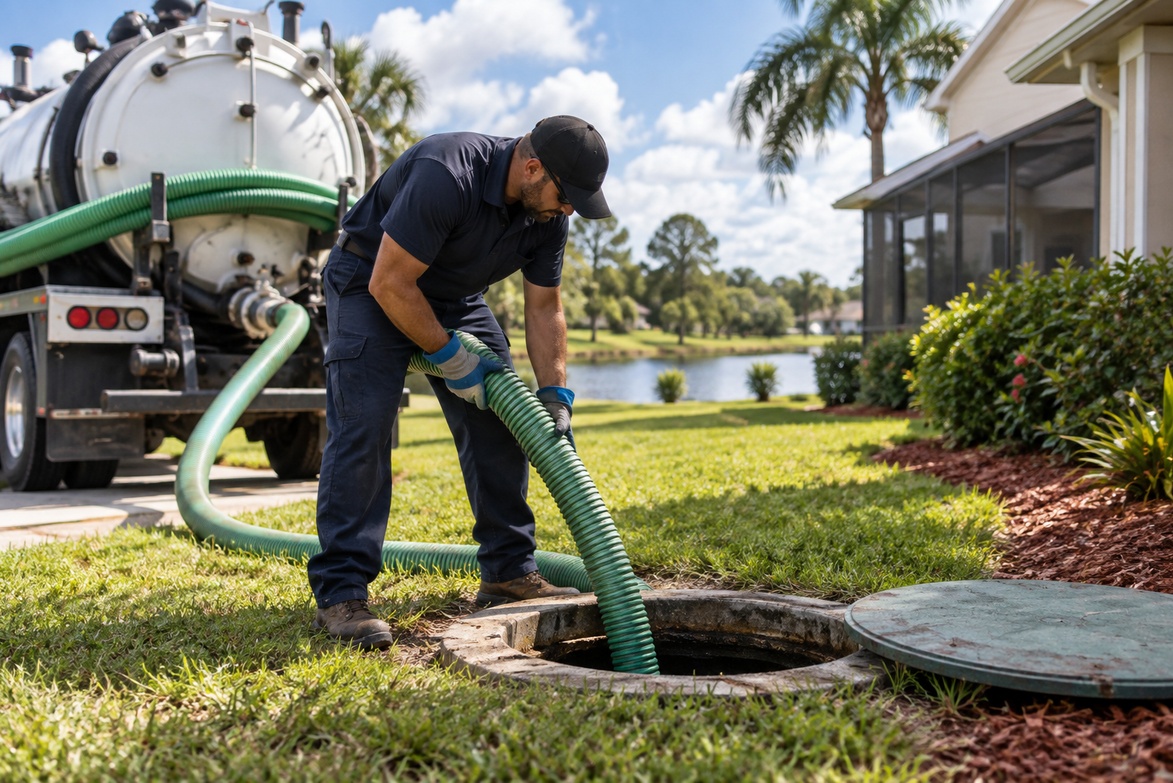
A septic tank pump-out is a straightforward process when access to the tank is clear, and for most Kissimmee residential systems it takes between one and two hours from truck arrival to completion. The technician locates the tank access lid, which on older systems may require probing the yard if the lid is buried, opens the tank, and uses the truck's vacuum equipment to remove the accumulated solids and liquid from both compartments of the tank. A two-compartment tank needs both sides emptied for the pump-out to be effective, and any technician who vacuums only one side has not completed the job.
While the tank is open, the technician inspects the inlet and outlet baffles, which are the components that direct flow into and out of the tank and prevent solids from reaching the drain field. Damaged or missing baffles are a common finding on older systems and a significant contributor to drain field problems when they go undetected. The inspection takes a few minutes and adds meaningful diagnostic value to a service visit that would otherwise address only the immediate capacity issue.
After pumping, the technician can run water through the system briefly to confirm that flow from the house to the tank is moving correctly and that the outlet side is not restricted. The whole visit, including the pump-out, the inspection, and the brief flow test, typically wraps within the two-hour window for a standard residential tank. Systems with buried lids, difficult access, or unusually large tank volume may run longer, but a technician who has been to thousands of Kissimmee-area properties can give a reasonable estimate when you call.
Why Does Waiting Risk Costly Drain Field Damage?
We helped a family who had inherited an older home in the Kissimmee area with an aging septic system that had not been serviced in several years. When slow drains and a persistent foul odor appeared, they were worried that ignoring the problem could turn the backyard into a sewage situation that would cost far more than a pump-out to resolve. They were right to be concerned. We explained what was happening inside the tank, walked them through the pump-out and inspection process, and got the system emptied before the saturated drain field had time to fail. Addressing it when they did kept the repair scope limited to the service call. Waiting another week or two likely would not have.
The drain field is the most expensive component of a septic system to repair or replace, and it is the component most directly damaged by a tank that has been allowed to overflow or back up repeatedly. When the tank is full and effluent cannot move from the house into the tank, the system either backs up into the house or pushes partially treated waste directly into the drain field lines in a higher concentration than the soil can process. That overload clogs the perforated pipes and the surrounding drain field medium with solids that should have been retained in the tank. Once the drain field is compromised, a pump-out alone does not fix it.
A drain field repair or replacement in Osceola County is a significant project involving excavation, new distribution lines, and in some cases a complete system redesign if the original field cannot be rehabilitated. That project costs several times what a same-day pump-out costs. The pump-out you call for today is not just solving the immediate problem. It is protecting the drain field from the kind of damage that turns a service call into a major repair.
How Do You Prepare Access for the Pump Truck Before We Arrive?
Getting the truck to your tank quickly starts with access. Septic pump trucks are large vehicles that need a reasonably clear path from the street or driveway to within hose reach of the tank lid, which is typically within about fifty feet. If there are vehicles parked along the access route, moving them before the truck arrives eliminates the delay of repositioning on-site. Gates to the backyard should be unlocked and swung open so the crew does not have to wait for someone to find the key.
If you know where your septic tank lid is located, mark it before the truck arrives. A flag, a garden stake, or even a piece of furniture placed on top of the general area saves the technician the probing time that adds to the service duration and occasionally to the cost if significant excavation is required to expose a buried lid. If you do not know where the tank is, tell us when you call and a technician can often locate it from the property records or with a probe before beginning the pump-out.
Keep the area around the tank access clear of children and pets during the service. The pump-out process is not dangerous to bystanders at a normal distance, but an open septic tank is not a safe area for anyone who does not need to be there. The technician will let you know when the work is complete and the lid is secured.
If your Kissimmee home is showing signs of a full septic tank, do not wait to find out whether the weekend will end with sewage on the floor. Call Centrel Services at (321) 363-1995 or contact us online for same-day septic tank pumping and let us take the problem off your hands before it gets worse.