
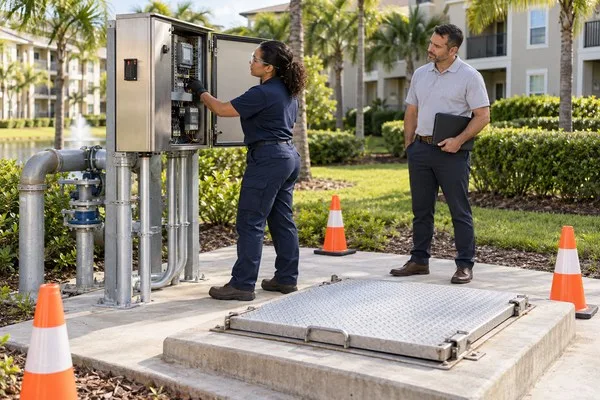
If your property or HOA owns a private lift station, someone on your team is on the hook every time the alarm sounds. Without a plan, that usually means a scramble for whoever can come out fastest, at whatever price they quote.
A lift station maintenance contract replaces that scramble with a schedule. To start building a service plan for your property, contact our team or call (321) 363-1995.
What does routine lift station maintenance include?
Routine service keeps the pumps, floats, controls, and wet well working before anything fails. A typical visit includes inspecting and testing each pump, checking the float switches and alarm, and removing grease and debris from the wet well.
Technicians also check the control panel for loose connections, signs of moisture, and worn relays. They confirm that the pumps alternate properly, so one pump is not doing all the work and wearing out years early.
The wet well needs regular attention too. Grease, wipes, and sand settle at the bottom and coat the floats. Once a float sticks, the pump may not turn on when it should, or it may run until it burns out.
Properties near Lake Toho often deal with high groundwater during the rainy season, which can add infiltration to the system and make the pumps work harder. Routine visits catch that extra strain before it turns into a failure.
What are the warning signs that a lift station pump is failing?
The clearest signs are frequent alarms, pumps that run longer or cycle more often than usual, and unusual noise or vibration. A sewage odor around the station or slow drains in nearby units are also red flags.
Many boards only notice the alarm, but the earlier signs show up first. A pump that hums without moving water, a breaker that trips repeatedly, or a panel light that stays on all point to a problem building quietly.
Residents often report these issues before anyone else does. A homeowner who mentions gurgling toilets or a smell near the entrance is giving you an early warning worth acting on.
In communities off US 192, where a single station can serve dozens of homes, one weak pump puts the whole neighborhood at risk. When the backup pump has already been carrying the load, there is nothing left to fall back on when the second one fails.
How does the cost of an emergency overflow compare to a maintenance contract?
An emergency overflow almost always costs more than a year of scheduled maintenance. You pay for the after-hours callout, the emergency pump repair or replacement, and the cleanup of any sewage that reached the ground or the street.
The costs keep going after the pump is fixed. An overflow may need to be reported to regulators, and any spill that reaches a storm drain, a pond, or a resident's yard brings cleanup, possible fines, and angry calls to the board.
For communities in areas like Buenaventura Lakes, where many HOA retention ponds sit close to homes, a spill can reach water quickly. That turns a mechanical failure into an environmental and liability issue.
A maintenance contract turns those unpredictable costs into a steady, budgeted line item. Boards can plan around a known service fee far more easily than a surprise invoice in the middle of the fiscal year.
What should a good lift station service agreement cover?
A good agreement spells out the visit schedule, what each visit includes, emergency response terms, and how findings are reported. It should also make clear who to call when the alarm goes off, so it is no longer a board member's personal phone.
An HOA board member called us because he was frustrated with being the point person every time the lift station alarm went off. When he got a call during his goddaughter's recital, that was the last straw. We set his community up with a recurring service plan, so his phone would stop ringing at the worst possible moments.
Look for written service reports after every visit, a clear priority for emergency calls, and recommendations for parts that are nearing the end of their life. Those reports also give the board a record to show residents and auditors.
Our lift station services team builds each plan around your station's size, age, and usage, so you are not paying for visits you do not need.
Stop managing your lift station one alarm at a time. Call Centrel Services at (321) 363-1995, or request a service plan for your Kissimmee property today.