
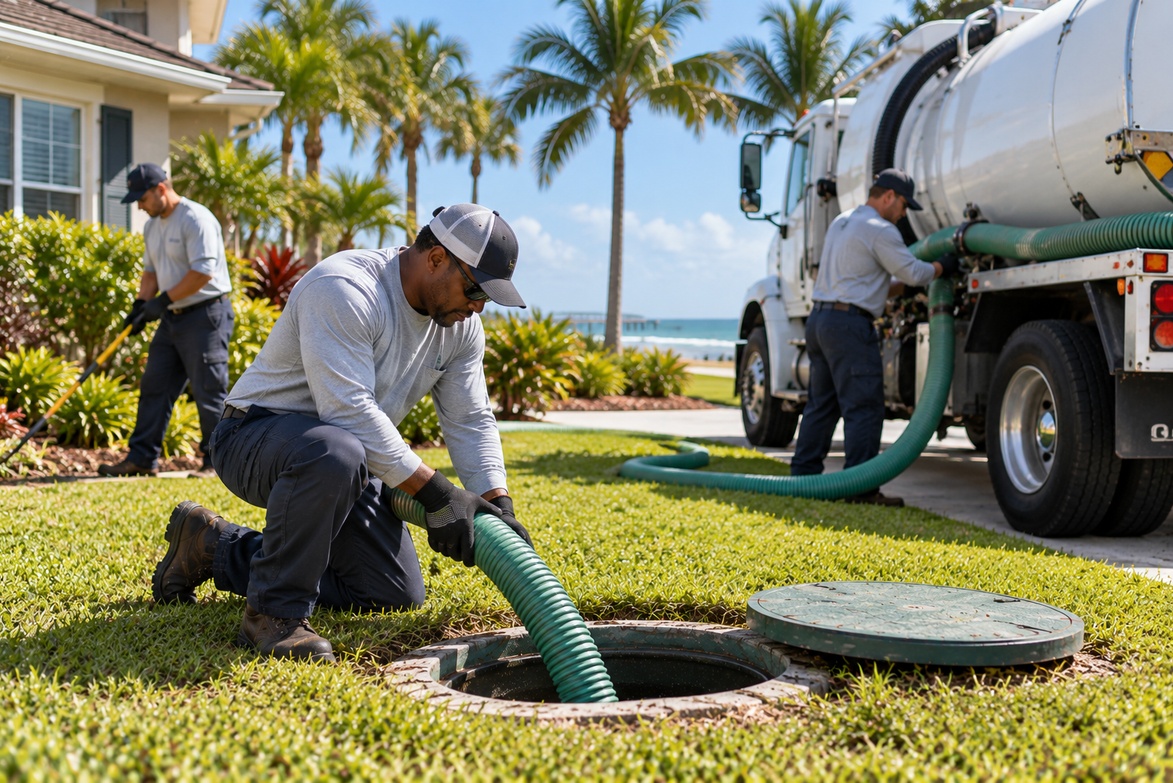
Daytona Beach septic systems work harder than most homeowners realize, and the ones that stay trouble-free almost always belong to homeowners who keep up with a consistent maintenance schedule rather than waiting for problems to announce themselves. Centrel Services can set you up with a recurring plan before the rainy season puts extra pressure on the system. Call (321) 363-1995 or reach out online to get started.
A septic system that is humming along quietly tends to stay that way when it is maintained on schedule. The same system left to run without attention tends to give out at the worst possible time, usually a holiday weekend or the peak of a wet summer when the water table is already high and the drain field has no margin left. For Daytona Beach homeowners, the combination of coastal soil conditions and Florida's rainy season creates a specific set of challenges that make proactive maintenance more than a good idea. It is genuinely the more economical path when you look at what reactive repairs cost.
How Do Daytona Beach's Coastal Water Table and Soil Conditions Affect Service Intervals?
Volusia County's coastal geography puts many Daytona Beach properties on sandy, porous soil with a water table that rises meaningfully during the wet season and after significant rain events. That combination affects septic system performance in ways that inland systems do not experience to the same degree. When the water table rises close to the depth of the drain field, the soil's ability to accept and treat effluent decreases. A drain field that performs adequately during dry months may struggle to keep up during a sustained rain period in July or August when the surrounding soil is already saturated from below.
This seasonal variability is why the standard three-to-five-year pumping interval that applies in other climates often needs to be shortened for Daytona Beach properties. A system serving a household of four in a coastal county with a high wet-season water table is more likely to benefit from a three-year pumping cycle, or even a more frequent one depending on usage patterns, than a comparable system in a drier inland location. Going longer between pumpings in this environment allows solids to accumulate to levels that the system cannot buffer against during peak stress periods.
Sandy soil also means that some drain fields in the area drain aggressively in dry conditions, which can mask early signs of system stress that would be more visible in heavier soil. A drain field that appears to be performing fine based on surface appearance during the dry season may be struggling to maintain adequate treatment when the water table rises and slows percolation. Scheduled inspections that look at the system during different seasonal conditions give a more complete picture of how the system is actually performing than a single visit in the most favorable month of the year.
What Does a Septic Maintenance Visit Actually Cover?
A maintenance visit is not just a pump-out with a different label. A comprehensive service visit covers the tank condition, the baffles, the drain field, the distribution box if the system has one, and the overall flow picture from the house through the tank and out to the field. Each of those components can develop problems independently, and a visit that only addresses the tank while ignoring the condition of the outlet baffle or the distribution box is leaving known failure points uninspected.
The tank inspection during a maintenance visit checks the inlet and outlet baffles for damage or deterioration. The outlet baffle in particular is critical because it prevents solids from leaving the tank and entering the drain field. A baffle that is cracked, detached, or missing is allowing material into the drain field that the drain field is not designed to handle, and that contamination accumulates over time regardless of how recently the tank was pumped. Catching a damaged baffle during a maintenance visit and replacing it is a minor repair. Discovering it after the drain field has been receiving solids for an unknown period is a significantly larger problem.
The drain field assessment during a maintenance visit looks for the early indicators of stress: unusual surface moisture, unexpected green patches over the field lines, or soft ground that suggests effluent is not percolating at the rate it should be. Finding those indicators early means addressing a developing issue before it progresses to surfacing effluent or indoor backup. A technician who visits the property regularly over several years also develops a baseline picture of what normal looks like for that specific system, which makes deviations from that baseline much easier to identify and act on promptly.
How Does Scheduled Pumping Protect the Drain Field?
We set up a recurring maintenance plan for a young couple who had just bought their first home in the Daytona Beach area. They had enough on their plate adjusting to homeownership without adding septic system worry to the list, and they wanted to know that someone was looking out for the system on a schedule rather than waiting for something to go wrong. We put together a plan that scheduled their pumping at the right interval for their household size and their property's soil conditions, built in a pre-rainy-season inspection each year, and gave them a direct number to call if anything came up between scheduled visits. They went from anxious first-time homeowners wondering what the septic system was going to do during a Florida summer to homeowners who knew the answer in advance.
The connection between pumping frequency and drain field health is direct and well-documented. A tank that is pumped on schedule stays at a solids level where the liquid layer above it has adequate residence time for treatment before moving to the drain field. A tank that is overdue for pumping has a solids layer high enough that the effective liquid treatment zone is reduced, and the effluent leaving the tank carries a higher concentration of organic material than the drain field soil is designed to process. That overloading creates the biomat layer that forms on the drain field soil interface and progressively reduces absorption capacity.
Once biomat has formed significantly, the drain field needs rest and reduced loading to recover, and in advanced cases it does not recover at all. A drain field that has been receiving overloaded effluent for several years may require partial or full replacement even if the tank itself is pumped regularly from that point forward. The damage is cumulative and it is largely irreversible past a certain stage. Scheduled pumping prevents the tank from ever reaching the solids level that starts that process, which is the simplest and most cost-effective way to protect the most expensive component of the system.
What Are the Long-Term Savings Compared to Reactive Repairs?
The financial case for a maintenance plan is straightforward when the numbers are laid out side by side. A scheduled pumping every two to three years for a typical Daytona Beach household costs a predictable amount per cycle. An emergency pump-out on a weekend because the system has backed up costs more than a scheduled visit due to the urgency premium and the logistics of responding on short notice. A drain field repair costs several times what a pump-out costs. A drain field replacement is a permit-required excavation project that can reach into the tens of thousands of dollars depending on the system size, the soil conditions, and whether the original field location can still be used.
Homeowners who have been through a drain field replacement almost universally say the same thing afterward: they wish they had known what consistent maintenance would have cost by comparison. The math is not close. A maintenance plan that keeps the tank at appropriate solids levels, catches baffle and distribution box issues early, and gives the drain field a fighting chance against Daytona Beach's seasonal water table pressure costs a fraction of what the alternatives cost when they eventually arrive, and they do eventually arrive when maintenance is deferred long enough.
If you are ready to stop wondering when the septic system is going to create a problem and start knowing that it is being looked after on a schedule, call Centrel Services at (321) 363-1995 or contact us online. Our septic tank services in Daytona Beach include recurring maintenance plans and septic tank pumping on a schedule that fits your property and protects your system through every rainy season.