
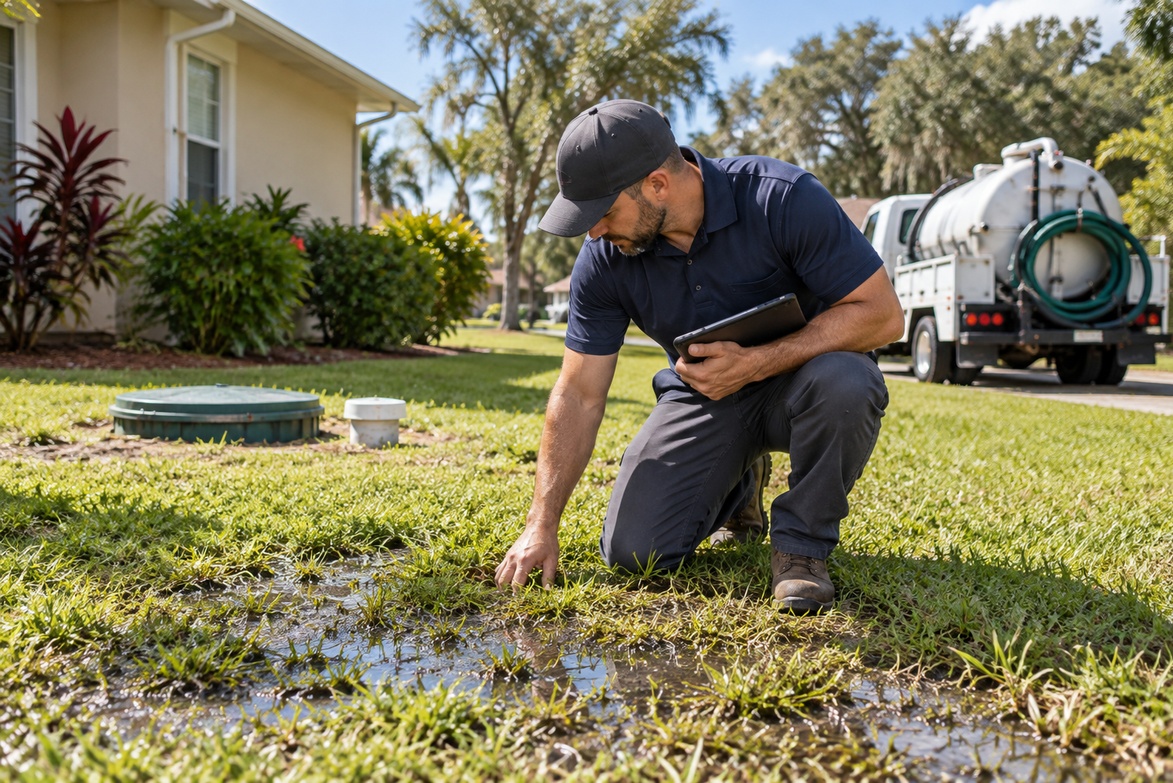
A soggy patch of yard that will not dry out, slow drains that have been getting worse over several months, or a sewage smell that shows up after rain are all symptoms worth taking seriously. The sooner an Apopka homeowner calls for an evaluation, the better the odds of catching a drain field problem while repair is still a realistic option. Call Centrel Services at (321) 363-1995 or schedule an inspection online before the problem spreads further.
Drain field problems have a way of developing quietly until they are not quiet at all. A system that is beginning to fail gives early signals that are easy to attribute to something else, and by the time the symptoms become undeniable, the damage has often progressed past the stage where the simplest fixes apply. Apopka's sandy soils in some areas and heavier clay soils in others affect how drain fields fail and how quickly, which makes local experience with Orange County's soil conditions a real factor in diagnosing what is actually happening underground. Here is what to look for and what it typically means.
What Are the Visible Symptoms of a Stressed Drain Field?
The most obvious symptom is the one that brings most homeowners to the phone: a section of the yard that stays wet or spongy when the surrounding ground is dry, often directly over the drain field lines. That standing moisture is effluent that has saturated the soil and can no longer percolate as designed. When the soil's ability to absorb and treat wastewater is exhausted, the liquid finds the path of least resistance, which is upward. The result is wet ground, a persistent sewage odor at ground level, and in worse cases a visible sheen or discoloration in the saturated area.
Unusually lush, dark green grass directly over the drain field lines is an earlier version of the same problem. The excess nutrients in surfacing effluent act as a fertilizer, and the grass responds before the homeowner has any other indication that something is wrong. If a particular strip of the backyard is noticeably greener than the rest during dry weather, it is worth noting where the drain field runs relative to that strip.
Indoors, a stressed drain field makes itself known through slow drainage and sewage odors that worsen after rain or after periods of heavy water use. Rain saturates the soil further, reducing the drain field's already-limited capacity and pushing symptoms back into the house. A toilet that gurgles when a washing machine drains, or a shower that backs up temporarily after several people have used it in quick succession, is a sign that the downstream system is not handling flow at the rate the household generates it. These symptoms do not resolve on their own.
What Causes a Drain Field to Fail in the Apopka Area?
The most common cause of drain field failure in residential systems is overloading, which happens when the system receives more wastewater than the drain field's soil capacity can process. This can be a gradual process tied to household size changes, increased water use, or simply a system that was sized for lighter use than it has experienced over the years. It can also happen suddenly when a large gathering, an extended visit, or a water leak sends far more flow through the system than it is designed to handle.
Solids reaching the drain field accelerate the overloading problem. When a septic tank has not been pumped on a regular schedule, the accumulated solids eventually reach the outlet level and begin passing into the drain field lines. Those solids clog the perforated pipes and the surrounding gravel or drain field medium, reducing the effective absorption area and concentrating flow into whatever sections of the field are still open. This is why a consistently maintained tank and a failing drain field are rarely found together, and why overdue pumping is a contributing factor in a significant share of the drain field problems we diagnose in Apopka properties.
Root intrusion is the other common culprit, particularly in older Apopka neighborhoods where mature trees have had decades to extend root systems into the underground drainage infrastructure. Tree roots are drawn to the moisture and nutrients in the drain field area and will find their way into perforated pipes through any available opening. A root mass inside a drain field pipe reduces flow capacity and eventually blocks it entirely. This type of failure often presents in one section of the drain field while others remain functional, which is a useful diagnostic signal because it typically points toward repair rather than full replacement.
Why Does Early Repair Beat Waiting for Full Replacement?
A homeowner in the Apopka area came to us after months of slow drains that the family had attributed to the quirks of an older house. The symptoms had been building gradually enough that no single moment felt urgent enough to call. It was only when the sewage odors in the yard became strong enough that their teenage daughter started joking about moving out that the family recognized the situation had crossed a line. By then, the drain field was stressed enough that we needed a full evaluation to determine how much of it was still salvageable. We diagnosed the problem, explained the options honestly, and helped the family make a decision based on what the system actually needed rather than the worst-case scenario they had imagined. Catching it earlier would have left more options on the table.
Early intervention matters because drain field damage is cumulative. A section of field that is stressed but not yet saturated can sometimes be rehabilitated through a combination of septic tank pumping to reduce the load, rest periods to allow the soil to recover, and targeted repair of the affected lines. A field that has been operating in a failed state for an extended period accumulates biomat, a biological crust that forms on the soil surface and further limits absorption, and that damage is much harder to reverse than the original problem.
Full drain field replacement in Orange County involves permitting, excavation, installation of new distribution lines and drain field medium, and final inspection. It is a significant project in both cost and disruption to the property. A targeted repair that addresses a failing section while the rest of the system remains functional costs a fraction of that. The difference between those two outcomes frequently comes down to how quickly the homeowner called after the first symptoms appeared.
What Does an On-Site Inspection Reveal That Symptoms Alone Cannot?
Symptoms tell you that something is wrong. An inspection tells you what is wrong and where, which determines what the fix actually looks like. A drain field evaluation typically begins with a review of the system's service history and any available records of the original installation, which in Apopka includes properties going back decades with original systems that may have been modified, extended, or never properly documented.
The physical inspection covers the tank condition, the inlet and outlet baffles, the distribution box if one is present, and the drain field lines. A technician who has diagnosed failing systems throughout Orange County knows what a saturated field looks like, how root intrusion typically presents, and how to distinguish a section of field that is recoverable from one that is not. That field assessment, combined with a flow test and a review of the tank condition, produces a diagnosis specific to the property rather than a generic recommendation based on symptoms alone.
In some cases, camera inspection of the drain field lines is the most direct way to identify the location and nature of a blockage, particularly when root intrusion is suspected. The camera confirms exactly where the problem is and how extensive it is, which prevents unnecessary excavation in sections of the field that are still functioning and focuses the repair where it is actually needed.
If your Apopka yard has soggy spots, your drains have been slow, or the smell after rain has been getting harder to ignore, the right call is an on-site evaluation now rather than a larger repair later. Call Centrel Services at (321) 363-1995 or request your inspection online to find out what your system actually needs. Our drain field repair and replacement team serves Apopka and the surrounding Orange County area and can give you an honest assessment of what the right solution looks like for your property.