
If you're looking to buy a home in Volusia County, you're probably already familiar with our predictable summer weather. At 3:00 PM, like clockwork, the skies open up, and thousands of gallons of water hit the pavement. When you see that water rushing down the street, it disappears into a grate. But do you know where it goes?
Many prospective buyers assume all drains are the same. They aren't. Understanding the difference between a storm drain and a sanitary sewer is vital for protecting your property value and our local waterways. Mixing them up leads to pollution in the Halifax River and expensive plumbing backups in your new home.
What is a Storm Drain?
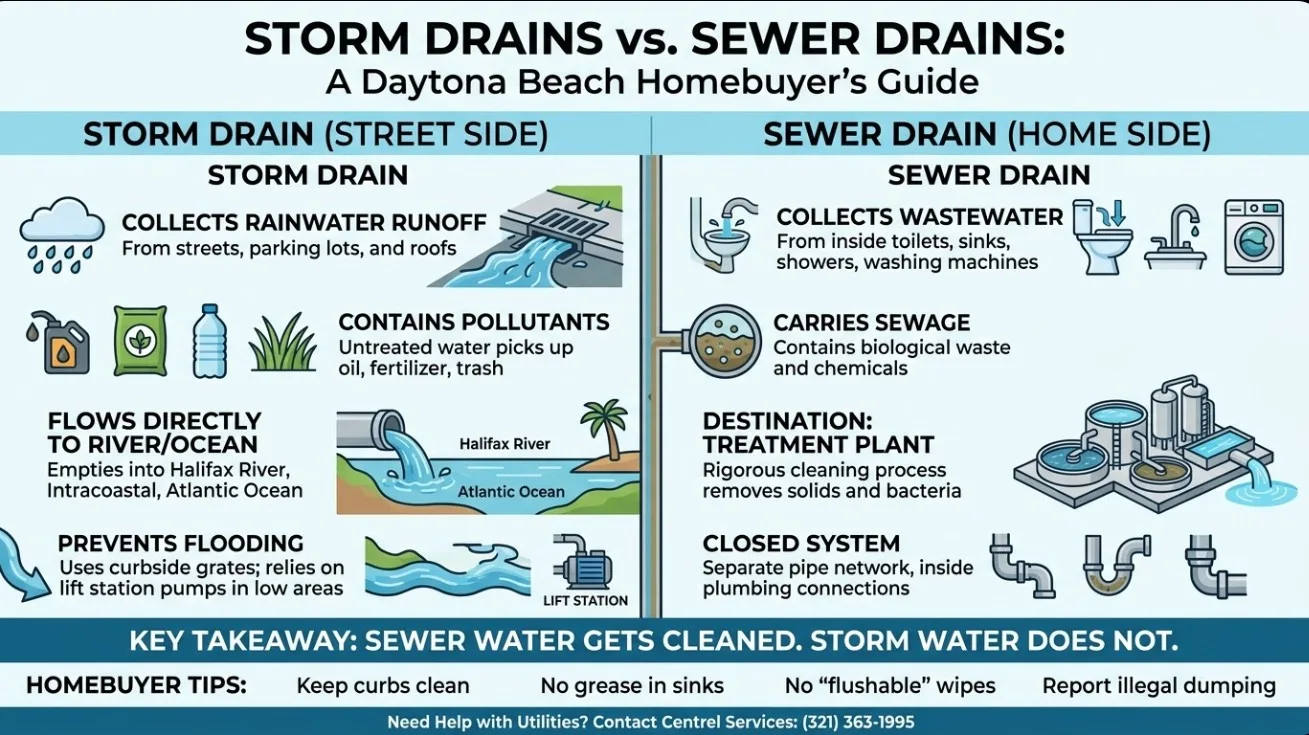
A storm drain is a system designed to catch rainwater runoff from streets, parking lots, and roofs to prevent flooding. Unlike the water in your toilet, the water entering a storm drain Daytona Beach residents see on the street corner, flows directly into local water bodies without being treated.
When rain hits the pavement, it picks up oil, fertilizer, grass clippings, and trash. This runoff travels through underground pipes and empties straight into the Halifax River, the Intracoastal Waterway, or the Atlantic Ocean. Because this water doesn't go to a treatment plant, anything that goes down that grate ends up in the environment.
In low-lying areas near the beachside or downtown, these systems rely on pumps to move water against gravity. Our team handles lift station services to keep these pumps running. Without them, heavy summer storms would leave streets underwater in minutes.
How Does a Sanitary Sewer Drain Work?
Sewer drains carry wastewater from inside your home—toilets, sinks, showers, and washing machines—to a wastewater treatment facility. This is a closed system completely separate from the storm drains.
When you flush a toilet in a neighborhood like Pelican Bay or Indigo Lakes, that waste travels through a series of pipes to a treatment plant. There, it undergoes a rigorous cleaning process. The facility removes solid waste, bacteria, and pollutants before the treated water is safely released back into the environment or reused for irrigation.
The cost of this service shows up on your monthly utility bill. In Daytona Beach, sewer charges are typically based on your water usage, often ranging from $60 to $100 a month for an average family.
What Are the Key Differences?
The main difference is treatment: sewer water gets cleaned, while storm water does not. Sanitary sewers are designed to handle biological waste and chemicals from your home, whereas storm drains are strictly for rain.
Here is the breakdown of how they differ:
Destination: Sewer pipes lead to a treatment plant. Storm pipes lead to the nearest river, lake, or ocean.
Content: Sewers carry sewage (blackwater and greywater). Storm drains carry rain and runoff.
Structure: Sewer openings are inside buildings. Storm drain openings are curbside grates or inlets.
This distinction affects how new communities are built. When we work on site development & underground utilities, we install two completely distinct pipe networks. Crossing these lines is illegal and dangerous. If a sewer line connects to a storm pipe, raw sewage dumps right into the river. If a storm drain connects to a sewer pipe, a heavy rainstorm will overwhelm the treatment plant and cause sewage to back up into people's bathtubs.
Why This Matters for Daytona Beach Real Estate
Understanding your drainage system helps you avoid fines and protects the local ecosystem that drives our property values. Because a storm drain Daytona Beach uses connects to the ocean, dumping anything other than rain down it is a violation of Florida law.
We've seen new homeowners unknowingly wash paintbrushes or drain their pools into the street gutter. This seems harmless, but it introduces chemicals directly into the habitats of manatees and dolphins. If local code enforcement catches this, fines can start around $100 and go up significantly for repeat offenses.
For buyers looking at older homes near Seabreeze Boulevard or Main Street, it's also smart to ask about the property's grading. You want to make sure the rainwater flows away from your foundation and toward the storm drain, not pooling against your house where it can cause structural damage.
Signs of Drainage Problems
Common signs of drainage issues include water pooling in the yard for more than 24 hours after rain, gurgling sounds in your toilets, or foul odors near street grates.
In our years serving Central Florida, we've learned that slow-draining yards often mean the storm system is clogged with leaves or debris. If the water creates a mini-lake in your front lawn every time it rains, the grading might be off, or the catch basin might be blocked.
On the sewer side, a slow drain inside the house usually points to a blockage in your lateral line (the pipe connecting your house to the city main). Clearing a main sewer line stoppage typically costs between $200 and $450, depending on the access point and severity of the clog.
How You Can Protect Your Home and Community
Keep the curb in front of your house clean. It sounds simple, but raking up leaves and grass clippings before they wash into the storm drain Daytona Beach infrastructure relies on prevents localized flooding.
- Never put grease down the sink: It hardens in the sewer pipes and causes backups.
- Don't flush wipes: Even "flushable" wipes snag on pipes and clog lift station pumps.
- Report illegal dumping: If you see someone pouring oil or chemicals into a street drain, report it to the city immediately.
- Maintain your swale: If your property has a grassy swale near the road, keep it free of obstructions so water can flow.
Expert Help for Your Underground Utilities
Whether you're buying a new home or developing a commercial property, knowing what's happening underground is just as important as inspecting the roof. The pipes beneath your feet determine whether your property stays dry during hurricane season and whether your plumbing works when you need it.
If you need a professional assessment of your sewer system or help with site utilities, don't guess. Contact Centrel Services at (321) 363-1995 today. We're here to help you make informed decisions about your property infrastructure.