
Why Replace a Grease Trap Instead of Just Pumping It?
Because eventually the tank is the problem, not what is sitting inside it. A grease trap that has lost its baffle, cracked at a seam, or rotted out around the inlet stops separating anything at all, and every pump out after that is money spent on a container that no longer works. That is the call Centrel Services answered on this commercial project in Tallahassee, Florida. The property was on city sewer, and the City of Tallahassee holds food service customers to its sewer use ordinance through its wastewater services division, so a failing interceptor is not something an operator can simply live with. Slow floor drains, a mop sink that backs up during dinner service, and odor at the cleanout are the usual warnings. Our crew staged in a narrow strip between the building wall and the parking lot, with a dumpster and a storage container already sitting in the work zone, which meant the excavator had to reach over the trench rather than work beside it. Routine commercial grease trap cleaning keeps a healthy interceptor healthy. It cannot save one that has already failed structurally.
What Goes Into Setting a New Grease Interceptor?
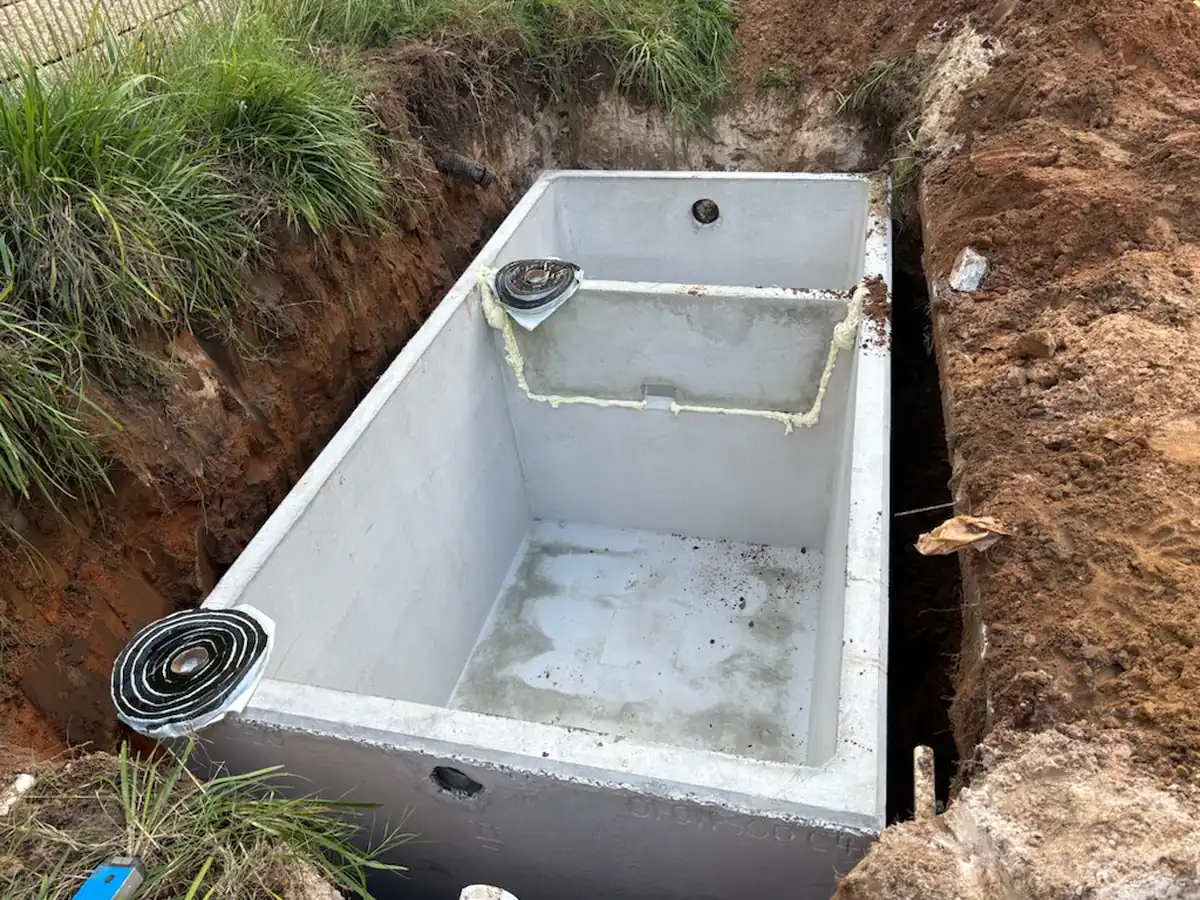
The tank goes in level, bedded, and sealed, or it will fail early no matter how good the concrete is. Our crew rolled out of the yard in Sanford, FL loaded for a one trip job, because on an out of town replacement there is no running back to the shop for a missing coupling. The photo shows the new two chamber precast interceptor set into the open cut, with the dividing baffle wall between the inlet side and the outlet side. That wall is the whole point of the device. Wastewater slows down, grease floats up and stays in the first chamber, solids drop to the bottom, and only the middle layer moves on toward the sewer. You can see black butyl sealant rope already coiled onto the riser collars, waiting for the lids. Everything the old tank held had to leave the site first as grease waste, which the state tracks from the pump truck to a permitted receiving facility under Florida DEP grease waste rules.

How Do You Keep a New Grease Trap From Leaking?
You seal it in two places: where the pipes pass through the concrete, and where the lid meets the tank. This interior shot shows both. The inlet stub is packed and troweled with grout where it penetrates the wall, and the pale bead running the perimeter is the sealant closing the joint between the baffle wall and the tank. Look closely at the pipe and you can see purple primer under the fitting, which is the small tell that the solvent weld was done right rather than glued dry. Watertight matters more here than most people expect. Tallahassee sits in the Red Hills, where the reddish loamy sand and clay mapped in the Tallahassee and Leon County soil survey behaves nothing like the loose sand we dig in every day across our Central Florida service areas. Clay holds a trench wall beautifully. It also holds water against the tank after a rain, and a tank that is not sealed lets that groundwater in, which floods the interceptor and pushes grease downstream.
What Should the Finished Lid and Access Openings Look Like?
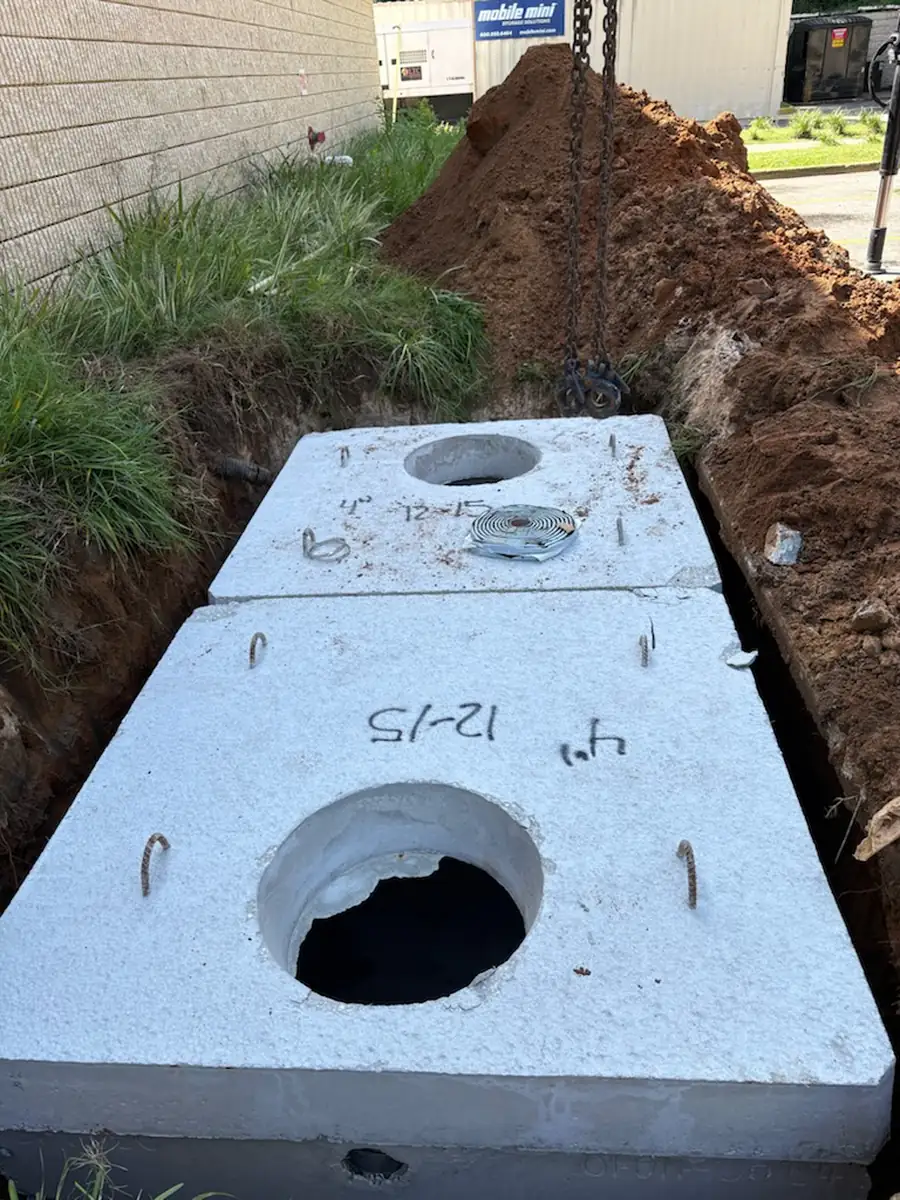
Two things: a tight seat, and a way back in without a shovel. The photo catches the precast lid sections coming down on chain, hooked to the rebar loops cast into the top for exactly that purpose. Chalk marks written on the concrete carry the field measurements the crew worked to, so nobody has to guess at the invert once the hole is half backfilled. Notice the two round openings. One sits over the inlet chamber and one over the outlet chamber, which is what lets a pump truck service both sides and lets an inspector actually see the baffle later. A single access hole would have been cheaper and would have made every future visit worse. The red spoil pile behind the tank is the same clay we cut through going down, and it gets replaced in lifts and compacted rather than dumped back in loose. Skip that step and the lid settles, the risers pull, and the seal you just paid for opens up. Related drain and sewer repair work often starts with exactly that kind of shortcut.

How Often Should a New Grease Trap Be Pumped?
Most food service operations land on a quarterly schedule, and the common trigger written into service agreements is pumping once grease and solids reach about a quarter of the liquid depth. Volume drives it. A busy fryer heavy kitchen can outrun a light one by months. This last photo is the finished product with the cast iron cover slid back, and it is worth studying for a second. The riser is seated flush enough to take traffic, the water inside is clear, and the sanitary tee on the outlet is hanging where it belongs, drawing from the middle of the water column instead of skimming the grease layer off the top. That tee is the piece that fails quietly on neglected tanks. When it breaks off, the trap keeps looking fine from the surface while it feeds grease straight into the lateral. Our team pulls the cover and checks it on every visit for that reason.
Is Your Grease Trap Backing Up Faster Than You Can Pump It?
Whether it needs a service schedule or a full replacement, Centrel Services handles commercial interceptors from the first look to the final lid.