
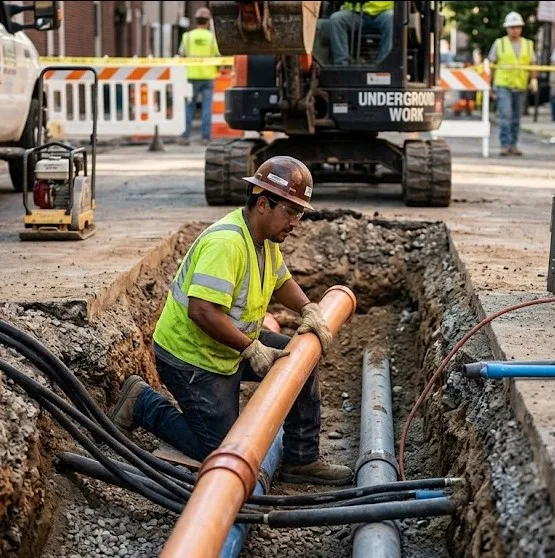
Renovating a property in Central Florida often involves more than just new drywall and paint. When your project requires digging trenches for water, sewer, or gas lines, you might assume your General Contractor (GC) handles it all. In Florida, however, underground work requires specific licensing that many general builders don't possess.
This distinction matters because Florida's sandy soil and high water table make underground work dangerous. A general contractor can oversee the project, but they usually cannot perform the excavation or pipe laying themselves. You need the right team for the job to avoid legal trouble and safety hazards.
What Licenses Are Required for Underground Work in Florida?
Florida law requires a specialized Certified Underground Utility and Excavation Contractor (CUC) license for most digging projects. While a General Contractor (CGC) can subcontract this work, they cannot perform the actual utility connections or excavation unless they hold this specific CUC license. State regulations strictly separate vertical construction from horizontal underground infrastructure to ensure public safety.
Under Florida Statute Chapter 489, the scope of work for underground utilities is distinct. A CUC license allows a pro to install, repair, and replace main sanitary sewer collection systems, water distribution systems, and storm sewer collection systems.
If your renovation involves fixing broken pipes beneath your driveway or foundation, you might need trenchless pipe lining and repair. This specialized method repairs pipes without extensive digging. A standard general contractor usually lacks the equipment and the specific licensure to perform this technical work legally.
Why Can’t My General Contractor Do It All?
General Contractors act like conductors of an orchestra; they manage the project but don't play every instrument. The state restricts them from performing specialized trades like plumbing, HVAC, and underground utilities to protect property owners. Underground lines often run near high-voltage power and gas lines, creating risks that general builders aren't trained to mitigate.
In our years serving Central Florida, we’ve seen GCs try to handle underground scopes to save time. It rarely ends well. The skills required to frame a house in Winter Park are entirely different from the skills needed to grade a trench properly so sewage flows downhill.
Most homeowners don't realize that Orange County code inspectors look for specific license numbers on the permit application for each trade. If your GC puts their number on the plumbing or underground utility line of the permit, the county will likely reject it. They know exactly who is allowed to touch what.
What Happens If You Hire Unlicensed Underground Workers?
Hiring unlicensed workers for underground projects leads to fines starting at $500 to $5,000 per offense for property owners. Beyond fines, the city can issue a "stop work order," forcing you to pause construction and potentially rip out completed work. If a worker gets injured in your trench, you could be liable for their medical bills since typical homeowners' insurance won't cover unlicensed labor.
We recently helped a customer in Kissimmee who had this exact problem. They hired a handyman to run a new sewer line to a guest house. The pipe wasn't bedded correctly in the soil, and a heavy rainstorm caused the trench to collapse and break the new line. Because the worker wasn't licensed, the homeowner had to pay for the entire repair twice.
When you need a reliable underground utility contractor Kissimmee residents rely on, checking for that CUC license is your first line of defense against fraud and liability.
How Much Does Legitimate Underground Work Cost?
Underground utility work typically costs between $50 and $200 per linear foot, depending on depth and soil conditions. For a sewer line replacement in established neighborhoods like College Park, expect to pay $3,000 to $7,000. While hiring an unlicensed handyman might save you 30% upfront, the cost to fix a botched installation often triples the original price.
Many older homes in Orlando also face septic issues. If you need drain field repair & replacement, the costs can range from $5,000 to $15,000, depending on the size of your home and the soil quality.
You shouldn't let sticker shock drive you to unlicensed labor. An underground utility contractor Kissimmee locals use will provide a detailed estimate that includes permitting fees and material costs. This transparency protects you from surprise charges later.
How to Verify Your Contractor’s Credentials
Verify a contractor's license immediately by searching the DBPR (Department of Business and Professional Regulation) website. Ask for their specific CUC license number, not just a business tax receipt. Legitimate pros will also carry General Liability insurance of at least $300,000 and Workers' Compensation, which you should verify by calling the insurance agent directly.
Don't just take their word for it. Look at the license card. It should start with "CUC" for underground utility contractors. If it starts with "CRC" (Residential) or "CBC" (Building), they likely need to sub out the underground work.
When to Call a Specialist
Call a specialist when your project involves digging deeper than a few inches or connecting to municipal systems. Whether you're dealing with a broken water main in Lake Nona or need a septic-to-sewer conversion, specialized experience matters. The Florida water table sits very close to the surface, meaning trenches can fill with water in minutes if not managed correctly.
Finding the right underground utility contractor Kissimmee homeowners trust doesn't have to be hard. Look for a team that owns its own heavy equipment and understands local soil conditions.
Need Help With Your Underground Project?
Don't risk your property or your wallet on unlicensed work. At Centrel Services, we have the licenses, the equipment, and the experience to handle your underground utility needs safely and legally.
Call us today at (321) 363-1995 for a free estimate. We’ll get the job done right the first time.