
Any utility contractor you hire should explain how existing lines, site conditions, and inspections for the project will be handled. Before you award sewer, water, or storm work, ask about licensing and insurance, trench safety, specialty experience, inspections and as-builts, and who maintains the system afterward. The answers tell you how the job will actually run.
At Centrel Services, we install underground utilities for commercial and community projects across Central Florida. Reach out to our team or call (321) 363-1995 to set up a pre-construction meeting.
What Licensing and Insurance Should the Contractor Carry?
Ask for the license numbers and a current certificate of insurance before you compare prices. An underground utility contractor in Florida should hold the right state certification for the work.
Check the license yourself through the Florida Department of Business and Professional Regulation's online search. Make sure the license is active and matches the company name on the bid. Centrel holds a Certified Underground Contractor license, CUC1225722, and a Certified Plumbing Contractor license, CFC1430739.
For insurance, ask for a certificate showing general liability and workers' compensation, and ask whether you or the owner can be named as additional insured. Confirm the limits meet your contract and lender requirements.
This matters even more on projects along the busy I-4 corridor, where work often sits near roads, neighbors, and existing infrastructure. Our underground utility installation page lists the utilities we install and how we run each project.
How Does the Contractor Handle Trench Safety and Existing Lines?
Ask exactly when shoring goes in and how crews work near existing utilities. A clear answer is a good sign. A vague one is a warning.
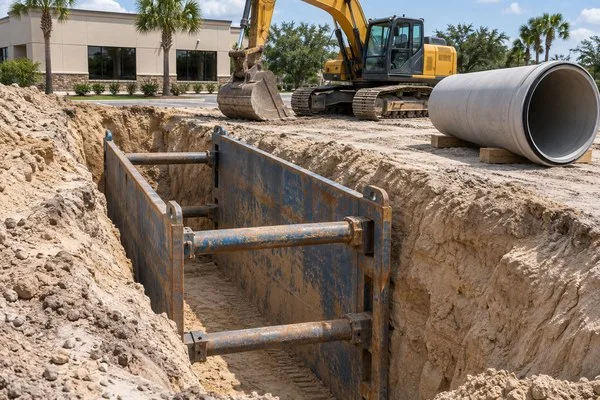
On deep cuts, our crews set a trench box before anyone climbs down. Near existing utilities, mechanical digging stops and crews dig by hand to prevent strikes. Ask any bidder to describe the same steps in their own words.
Our Orlando sewer main replacement shows how that works. A sudden collapse in an aging section of the municipal line caused backups that threatened several properties. Camera jetting mapped the inside of the line before excavation.
Crews then replaced hundreds of feet of damaged pipe with new SDR 35 PVC, working inside an aluminum trench box and hand-digging near existing utilities and at the final connection points.
Ask how the contractor plans the path, too. Knowing what is underground before digging keeps surprises out of the schedule.
Do They Have Experience With Lift Stations, Septic, and Sanitary Systems?
Ask for examples of similar systems, not just similar budgets. Sewer, water, storm, septic, and lift stations each come with their own rules.
We install water, sewer, storm, septic, and lift stations, along with the grading that ties them together. Septic work in Florida goes through the state's Onsite Sewage Program, while treatment plants fall under separate state permitting.
Our park sanitary system upgrade in Orlando is a good example. The park treats its own wastewater on site. We set two new ribbed polyethylene septic tanks side by side, joined with a PVC crossover, and threaded and installed new galvanized piping inside the concrete treatment basins. A sediment sock controlled runoff throughout the job.
Projects like schools, parks, and community centers bring their own oversight. Ask each bidder which agencies they have worked with and how they handle them.
How Will Inspections and As-Builts Be Handled?
Ask who schedules inspections, how lines are tested, and what documentation you get at the end. Those details protect your closeout and keep the owner's records complete.
On our projects, water lines get pressure tested and sewer gets flow tested, and we schedule every required inspection ourselves. We submit applications to the local building department, the water and sewer utility, and the state for any septic work. We also answer plan review comments.
At the end, you should receive as-built drawings showing where every line actually went. That record matters for future additions, repairs, and anyone who digs on the site later.
If a bidder treats as-builts as an afterthought, take note. Ask to see a sample set from a past job, and ask how quickly they are delivered after final inspection. The drawings you receive at closeout are the map the next contractor will rely on.
Why Does One Firm for Install and Maintenance Simplify the Project?
The firm that installed your utilities already knows where everything is and how it was built. That shortens every service call after the ribbon cutting and avoids paying someone to rediscover the site.
Beyond installation, we offer septic pumping, sewer camera inspection and jetting, lift station maintenance, grease trap service, and storm water repair. When the same team handles the system later, they start from their own as-builts instead of guessing.
That continuity helps facility owners most. One phone number, one set of records, and one team that knows the site keeps maintenance simple for years. For developers handing a project to an HOA or property manager, it also gives the new owner a clear contact from day one.
Ready to talk about your next project? Send us your plans for a bid, or call (321) 363-1995 to set up a pre-construction meeting.