
Many Orlando homeowners are getting letters from Orange County requiring them to connect to the public sewer system. If you're one of them, the first question is usually the same: how much is this going to cost me? The total bill for a septic-to-sewer conversion in Orlando typically runs between $8,000 and $20,000 or more, depending on your lot, your plumbing, and your location. That's a wide range, and this post breaks down exactly where that money goes.
Need help figuring out your options right now? Call Centrel Services at (321) 363-1995 for a free on-site assessment.
What Does the Septic-to-Sewer Conversion Process Look Like?
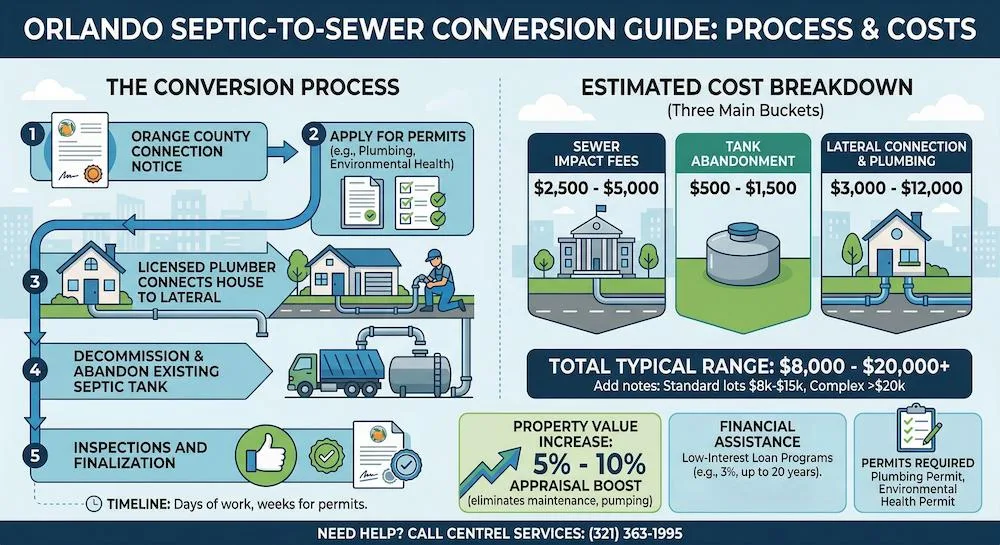
Converting from a private septic system to the public sewer involves three main steps: abandoning your existing septic tank, connecting your home's plumbing to the city sewer main, and paying the required fees to Orange County. The process typically takes two to five days of physical work, though permitting can add several weeks to your timeline.
Our technicians serving areas like Apopka and the surrounding communities have walked through this process with dozens of homeowners. The physical work itself is straightforward. The costs, however, can catch people off guard.
Here's the basic sequence:
- Orange County issues a connection notice (sometimes with a deadline of 1-3 years)
- Homeowner applies for permits through Orange County Environmental Health and the local municipality
- A licensed Florida plumber connects the home's drain lines to the sewer lateral at the property line
- The existing septic tank is pumped, crushed or filled with sand, and abandoned per county code
- Inspections are completed, and the connection is finalized
How Much Do Impact Fees, Abandonment, and Plumbing Really Cost?
The total cost of converting from septic to sewer in Orlando breaks down into three separate buckets. Expect to pay for each one.
Sewer Impact Fees: Orange County charges a sewer connection impact fee that typically ranges from $2,500 to $5,000 for a single-family home. This fee covers your share of the public infrastructure. Some municipalities within the county charge differently, so confirm the exact amount with your local utility authority early.
Septic Tank Abandonment: Before you can connect to sewer, your old tank has to be properly decommissioned. Florida regulations require the tank to be pumped out and either filled with sand/gravel or collapsed and buried. You can learn more about what that septic tank pumping process involves. Abandonment costs generally run $500 to $1,500 depending on tank size and accessibility.
Plumbing and Lateral Connection: This is usually the largest variable cost. Connecting your home's internal plumbing to the new sewer lateral at the street can range from $3,000 to $12,000. Distance from the street, the depth of the sewer main, and whether your yard requires extensive excavation all affect the price. Homes near Apopka's older subdivisions, for example, sometimes have deeper mains that add to excavation costs.
When you add it all up, a straightforward conversion on a standard lot often lands between $8,000 and $15,000. Complex jobs push past $20,000.
What Permits Does Orange County Require for Sewer Connection?
Orange County requires a plumbing permit for any sewer lateral connection. You'll also need an Environmental Health permit if your septic system is being formally abandoned. Permit fees generally run $150 to $400, and inspections are required at multiple stages of the work.
A licensed Florida plumber must pull the permits and perform the work. This protects you legally and ensures the connection passes inspection. Unlicensed work on sewer connections creates liability issues and can trigger fines under Florida Statute Chapter 489. Our team holds Florida Plumbing Contractor license CFC1430739 and Underground Utilities Contractor license CUC1225722, so every job is done by the book.
Don't skip the permit process to save a few hundred dollars. Orange County inspectors do follow up, especially on properties that received mandatory conversion notices.
Are There Financial Assistance Programs for Orlando Homeowners?
Yes. Orange County and the City of Orlando have offered low-interest loan programs to help homeowners cover sewer connection costs. These programs have varied over the years, so availability changes. The Orange County Septic-to-Sewer Loan Program has historically offered loans at rates as low as 3% with repayment terms up to 20 years. That turns a $10,000 conversion into a payment of around $55 per month.
Contact Orange County Utilities directly at (407) 836-7900 to ask about current program availability. Some HOA communities and municipal utility districts also offer payment plans for properties within designated connection areas.
Here's something many homeowners don't consider: a new advanced septic system can cost $15,000 to $25,000 installed. If you're weighing the cost of converting to sewer against the cost of replacing a failing septic system, the financials often favor conversion, especially when loan programs are available.
Does Connecting to Sewer Increase Your Property Value?
A sewer connection typically adds measurable value to an Orlando home. Properties connected to public sewer generally appraise 5% to 10% higher than comparable septic properties, according to appraisal industry guidance. Buyers also prefer sewer connections because they eliminate the ongoing maintenance, pumping costs, and liability that comes with a private septic system.
For homeowners in neighborhoods like Winter Garden or areas near the East Orange County expansion zones, sewer access is increasingly expected by buyers. A septic system that requires pumping every three to five years and carries the risk of drain field failure becomes a negotiating point during a sale. Sewer connection eliminates that conversation.
In our experience serving the greater Orlando area, we've seen properties with failed or aging septic systems sit on the market longer and close at a discount. Getting ahead of the conversion before you list is almost always the smarter move financially.
How Do You Find a Licensed Florida Plumber for Sewer Conversion?
Verify any plumber you hire holds an active Florida state license before they start the job. You can check license status at the Florida Department of Business and Professional Regulation (DBPR) website at myfloridalicense.com. Look for both a Plumbing Contractor license (CFC prefix) and, for larger excavation work, an Underground Utilities Contractor license (CUC prefix).
Ask the contractor directly whether they'll pull the required permits. A reputable plumber will always say yes. Anyone who suggests skipping permits to cut costs is a red flag.
For properties where you're also dealing with tree root intrusion in aging drain lines, or where you want to confirm your existing interior plumbing is in good shape before tying into the new sewer connection, a sewer line camera inspection is a smart first step. It takes about an hour and gives you a clear picture of what's happening inside your pipes before any excavation begins.
Our technicians have handled septic tank service in Apopka, Florida and throughout the surrounding communities for over 20 years. We see the full picture on these jobs, from the condition of the existing septic system to what the new sewer lateral work will realistically involve.
Is It Ever Worth Keeping Your Septic System Instead?
Sometimes. If you're not in a mandatory connection zone and your system is functioning well, replacing a failing septic system with a new advanced treatment unit (ATU) can make sense. A new ATU system costs $15,000 to $25,000 installed, includes ongoing maintenance contracts, and can extend your property's independence from municipal utility fees.
That said, if Orange County has sent you a mandatory connection notice, you don't have a choice. The county has actively expanded its sewer service territory as part of growth management, particularly in areas where high-density development has pushed older septic systems past their limits.
For those not under a mandatory order, the math depends on how old your current system is, how close the nearest sewer main runs to your property, and what impact fees will cost. A quick call to get a current impact fee quote from Orange County Utilities, combined with a site visit from a licensed contractor, gives you the real numbers to make that decision.
Get a Straight Answer on Your Conversion Costs
Every property is different. The only way to know what your conversion will actually cost is to have someone walk the property, check the sewer lateral location, and assess your existing system.
Centrel Services provides free on-site estimates throughout Central Florida, including septic tank service in Apopka, Florida and the greater Orlando area. We're licensed, insured, and have handled over 20 years of septic and sewer work across Orange, Seminole, Osceola, Volusia, and Lake counties. Call us at (321) 363-1995 and we'll tell you exactly what you're looking at before any work begins.