
Spring rain feels like a relief after a dry Florida winter. But if your yard starts showing soggy patches, strange smells, or slow drains right after a good downpour, your drain field may be sending you a serious warning. Contact Centrel Services at (321) 363-1995 before a small issue turns into a full system replacement.
Florida's rainy season doesn't just water your lawn. It tests your entire septic system. Apopka homeowners deal with sandy soil and high water tables that can push already-stressed drain fields to their limits. Knowing what to look for now can save you thousands of dollars later.
Why Do Florida's Spring Rains Hit Drain Fields So Hard?
Florida's spring rains stress drain fields faster than seasonal rain does in most other states. When 4-6 inches of rain fall in a single week, as Central Florida commonly sees between April and June, the soil around your drain field becomes saturated. A saturated drain field can't absorb treated wastewater from your septic tank. The system backs up. Fast.
Apopka's mix of clay-heavy and sandy soils makes this worse. Sandy soils drain quickly in dry conditions, but clay pockets trap water after heavy rain. If your property sits near Lake Apopka or any low-lying area, your yard is naturally more prone to seasonal saturation. That's not a flaw in your lot, but it does mean your drain field needs more attention than the average Central Florida home.
Our technicians find that properties in this area show drain field stress in spring more often than any other time of year. A little prevention in March or April stops most of the problems we see in June.
What Are the Warning Signs of a Failing Drain Field?
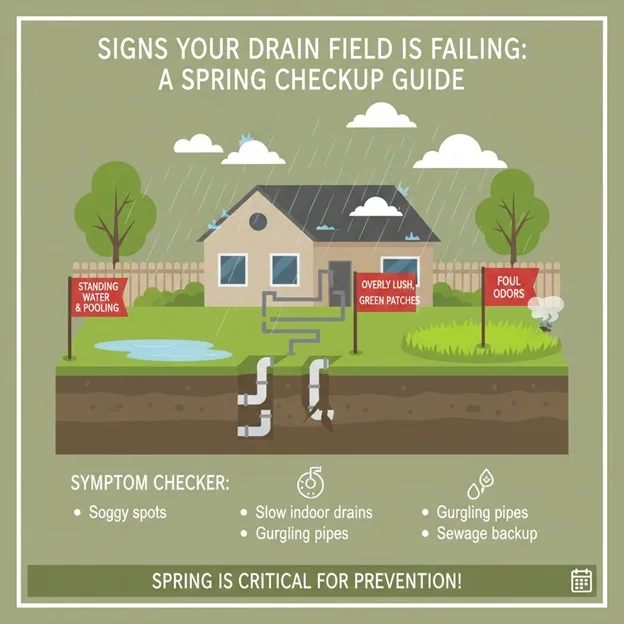
A failing drain field gives you clear warning signs before it completely fails. Spongy or soggy grass directly above the drain field lines, even during dry weather, is the most obvious red flag. Sewage odors in the yard, slow-flushing toilets across multiple bathrooms, and gurgling sounds in your pipes all point to the same problem: your drain field is struggling to process wastewater.
Here's what to walk your yard and check for:
- Spongy or wet grass directly above where your drain field lines run
- Bright green grass that grows faster and greener than the surrounding lawn (wastewater is acting as fertilizer)
- Standing water or muddy patches near the drain field, even days after rain
- Sewage odors near the tank or the drain field area
- Multiple slow drains inside the house at the same time
- Gurgling pipes when flushing or running the washing machine
One or two of these signs might point to a maintenance issue. Several at once usually mean the drain field is failing or saturated. Don't wait to see if it clears up on its own.
What Is the "Septic Sniff Test" and How Do You Use It?
The septic sniff test is a simple way to tell the difference between normal system operation and a drain field that's reached critical saturation. Walk the perimeter of your drain field on a calm morning, before afternoon winds pick up, and take note of any odors.
A healthy system produces no noticeable smell at ground level. A faint, earthy odor near the tank access lid is usually normal. What's not normal: a strong sulfur or sewage smell anywhere near the drain field lines or distribution box. That odor means liquid waste is surfacing instead of filtering through the soil. At that point, you have a saturation or failure problem, not just a maintenance issue.
Pay attention to the smell after rain, specifically 24-48 hours after a storm. If the odor gets stronger after rain rather than clearing up, your drain field soil is too saturated to absorb more liquid. That's the clearest signal that spring checkup time has arrived.
Spring Maintenance Checklist: What to Inspect Before Summer Hits
Running through a short checklist in March or April takes less than an hour and can prevent a $5,000-$15,000 emergency. Here's what to cover:
Septic Tank
Check when your tank was last pumped. Most Apopka households need septic tank pumping every 3-5 years. If it's been more than three years, schedule a pump out before the heavy rains arrive. A full tank during spring rains pushes solids into the drain field, clogging the soil and shortening the life of your entire system. Residential pumping in Central Florida typically runs $300-$500, depending on tank size and access.
Distribution Box
The distribution box sits between your tank and drain field and splits wastewater evenly between the drain field lines. If one section of your yard looks wetter than another, the distribution box may be uneven or damaged. A sewer line camera inspection can confirm whether flow is balanced or if one line is getting overloaded.
Yard Grading
Walk the area around your septic system and look for low spots where rainwater pools. Water should drain away from your drain field, not toward it. If grading has shifted over the years, correcting it before summer reduces the load on your system during peak rain months.
Landscaping Do's and Don'ts for Apopka Drain Fields
What you plant near your drain field directly affects how long it lasts. Florida's warm soil and year-round growing season means roots travel fast and far.
Do:
- Plant shallow-rooted grass like St. Augustine or Bahia over the drain field
- Keep the area mowed short to reduce moisture retention
- Direct gutter downspouts and irrigation runoff away from the drain field
- Leave a clear, accessible path to your septic tank lid
Don't:
- Plant trees or large shrubs within 30 feet of your drain field lines
- Run sprinkler heads over the drain field area (adding water on top of water is one of the fastest ways to saturate it)
- Park vehicles or place heavy equipment over drain field lines
- Plant vegetable gardens directly over the field due to contamination risk
Live oak and cypress trees, both common in the Apopka area, have aggressive root systems that seek out moisture. A tree planted 20 feet from your drain field today can cause root intrusion within 5-7 years. If you're landscaping near Northwest Recreation Complex or anywhere in the Errol Estate area where lot sizes run larger, give your drain field extra buffer room.
Repair vs. Replacement: What Does It Actually Cost in Central Florida?
When a drain field shows signs of failure, homeowners want to know one thing: how much will this cost? The answer depends on how far the problem has gone.
A drain field that's temporarily saturated from spring rains may recover with pumping, reduced water use, and time. That's the best-case outcome, and it costs $300-$500 for the pump out.
Partial repair, replacing one or two damaged lateral lines, typically runs $1,500-$4,000. Full drain field replacement in Central Florida averages $5,000-$12,000 depending on lot size, soil conditions, and system type. If the drain field has completely failed and soil remediation is needed, costs can reach $15,000 or more.
The math is straightforward: septic tank pumping in Apopka, Florida is a $300-$500 maintenance expense. Ignoring it until the drain field fails turns into a $10,000+ repair. Our technicians have seen systems in Wekiwa Springs-area neighborhoods that lasted 40+ years with proper maintenance and others that needed full replacement in under 15 years from neglect.
Early detection is everything. A sewer line camera inspection starting at $200 can identify a failing drain field before it causes a full backup, giving you time to plan and budget for repairs.
When Should You Call a Professional?
Call a licensed septic contractor if you notice any of the following: sewage odors that don't clear up within a day or two after rain, soggy ground above the drain field during dry weather, sewage backup into the house, or multiple slow drains that won't resolve on their own.
Don't wait for a backup to make the call. By the time sewage surfaces in your home, the drain field may already need full replacement rather than repair. Catching the problem at the "soggy yard" stage versus the "sewage in the bathroom" stage is often the difference between a $500 fix and a $10,000 one.
If your system is due for septic tank pumping in Apopka, Florida, or you've noticed any of the warning signs above, spring is the right time to act. Getting ahead of rainy season is far easier than trying to schedule emergency service when the whole neighborhood is calling at once.
Get Your Drain Field Checked Before Summer Storms Arrive
Centrel Services has served Apopka and Central Florida homeowners for over 20 years, handling everything from routine septic tank pumping to full drain field repair and replacement. Our licensed technicians know the soil conditions, rain patterns, and system types specific to this area.
Call us at (321) 363-1995 to schedule your spring inspection or request a free estimate. Same-day service is available for urgent issues.