
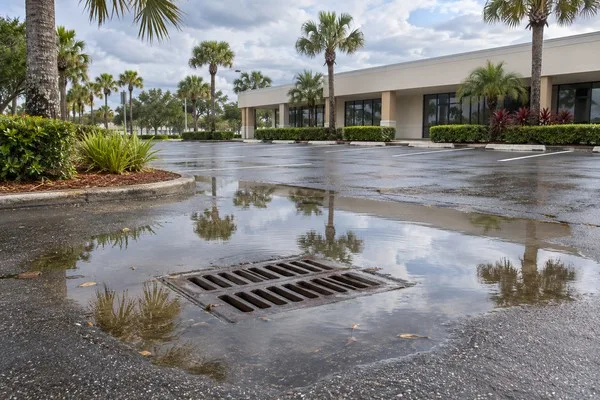
Puddles that won't go away after a storm need attention because the property could have drainage issues. If water ponds in the same spots after every heavy rain, call for a storm drain inspection before the next storm season. Ponding that lasts for hours or days usually points to a clog, damaged pipe, or a system that is too small for the site.
At Centrel Services, we inspect and repair storm water systems for commercial properties and HOA communities. Reach out to our team or call (321) 363-1995 to request an estimate.
What Do Clogged Inlets, Damaged Pipe, and Silted Structures Look Like?
Each one leaves clues on the surface. Learning to read them helps you describe the problem and decide how fast to act.
A clogged catch basin often looks like water sitting on top of the grate, or draining much slower than it should. Water pouring out of a grate during a storm means the system is clogged or undersized. Leaves, trash, and sand washing in from the lot are common culprits.
Damaged pipe shows up differently. Look for settling or sinkholes near drain lines, cracked pavement around structures, and erosion around the drains. Those can mean soil is washing into a broken pipe below.
Silted structures fill slowly over time. Sediment builds up in the bottom of catch basins until there is little room left for water. On a busy retail lot along International Speedway Boulevard, that buildup can happen faster than anyone notices. Our storm water systems page lists the warning signs we look for on commercial sites.
Why Is Standing Water a Liability Problem?
Standing water creates slip hazards, damages pavement, and brings complaints from tenants and customers. On commercial property, flooding can create serious liability and business interruptions.
Ponding near entrances and walkways is the most immediate concern. Water tracked inside makes floors slick, and puddles that linger can grow algae on the pavement. A slip near a storefront becomes your problem, not the rain's.
Pavement takes the next hit. Water that sits on asphalt and seeps into cracks weakens what is underneath. Over time, that turns into potholes and failing patches that cost more to fix than the drainage would have.
Then come the complaints. Tenants notice when customers have to step around puddles to reach the door. HOA residents notice standing water along sidewalks and parking areas, and boards hear about it at every meeting.
On a commercial strip along Seabreeze Boulevard, a parking lot that floods after every storm can shape how people see the whole property. If water starts reaching the building itself, the stakes rise even higher.
How Do Camera Inspection and Jetting Find the Cause Before Digging?
A camera shows what is happening inside the pipe, and jetting clears what is in the way. Together, they often reveal the cause without tearing up the lot.
We locate problems with camera inspection before planning repairs. The camera travels through the line and shows cracks, collapses, root intrusion, and buildup. That tells you exactly where the trouble is and what kind of repair it needs.
High-pressure water jetting removes debris, sediment, and buildup from storm drains and pipes. Sometimes cleaning alone restores flow. When it does not, the camera footage after jetting shows what remains.
Daytona Beach adds its own challenges. High water tables rise with tidal cycles, and heavy hurricane-season rain puts real stress on storm water systems. For an office park off LPGA Boulevard, knowing whether the problem is a clog, a break, or capacity keeps the fix targeted. Our Daytona Beach sewer services page covers the conditions we work with locally.
What Does a Storm Drain Repair or Upgrade Involve?
It depends on what the inspection finds. Repairs range from replacing a broken grate to rebuilding a structure or adding new catch basins and pipe.
We repair broken grates, rebuild cracked structures, and replace failed components. When the system is simply too small for the site, we can install new catch basins in parking lots and connect them to properly sloped pipe. Storm water work requires permits and must meet strict environmental regulations, and we handle the permitting, inspections, and documentation.
Our Daytona Beach storm drainage project shows the approach. On that residential site, we assessed the grading, installed catch basins along the driveway, and ran PVC lines sloped to move water away by gravity. Crews hand-dug near existing utilities and used a compact excavator for the long runs. After the next major downpour, the yard stayed dry.
Your lot deserves the same careful diagnosis. Call (321) 363-1995 or contact us to schedule a site visit and a storm drain inspection.