
What Does Grey Water Tank Cleaning on a Cutter Involve?
Three jobs in one visit. Centrel Services emptied and washed out the grey water holding tank aboard a US Coast Guard cutter berthed in Miami, cleared the drain lines feeding it, and buttoned the deck back up before the crew needed the space again. Grey water is everything that leaves the galley sinks, the crew showers, and the laundry. On a vessel it does not go over the side while tied up at a pier. It collects in a tank below the deck plates until a truck like ours takes it ashore. Sludge, soap scum, and hair build a layer in that tank the same way solids build in a septic tank, and the same equipment moves it. What changes is the paperwork and the access. Miami-Dade County requires anyone hauling liquid waste in the county to hold a DERM liquid waste transporter permit and to file electronic manifests for every load, so the permitting has to be settled long before a hose ever comes off the truck. The vacuum work itself is close cousin to septic tank pumping. The setting is what makes it a different animal.
How Do You Open a Grey Water Tank Below the Deck?
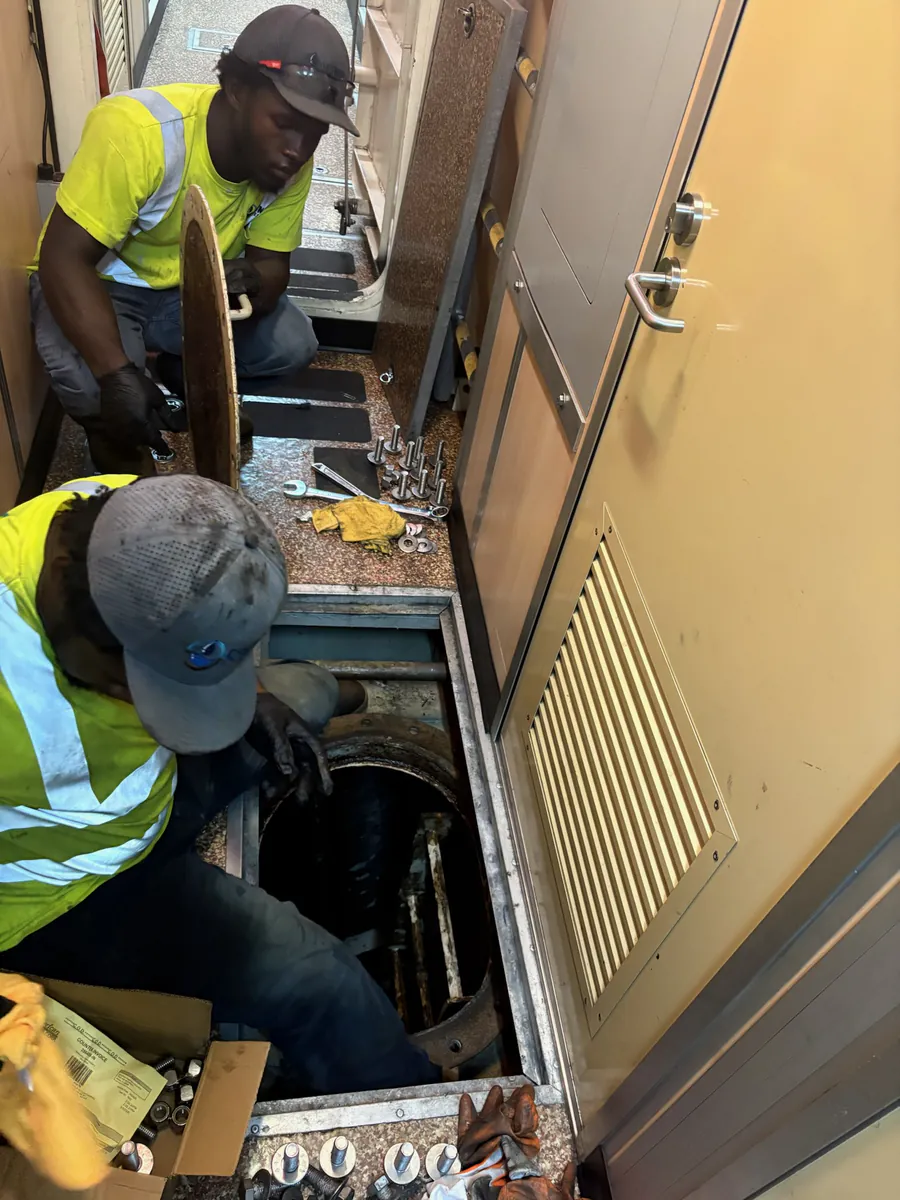
Slowly, and with every fastener accounted for. There is no riser and no shovel here. The tank top is the deck you are standing on, and the way in is a steel access plate bolted down through a gasket in the middle of a working passageway. In the photo you can see the crew has laid the bolts and washers out in order on the deck rather than dropping them in a bucket, because a fastener that goes missing on a vessel is a problem, and one that rolls into an open tank is a bigger one. Our guys came down from the yard in Sanford, FL for this contract. Once that cover lifts, the opening is treated as a confined space, with the air tested and the entry controlled before anyone reaches in. The reason all of this waste sits in a tank in the first place is regulatory. Florida DEP designates no discharge zones in state waters where nothing goes over the side, treated or not, so it holds until a shore contractor takes it.

Why Do the Showers and Sinks Get Jetted Too?
Because pumping the tank does nothing for the lines that feed it. Here one of our techs is working a jetter hose down the drain of a stainless crew shower, a stall roughly the size of a phone booth with a curtain for a door. Marine drain lines are small, they run flat for long stretches, and they bend around structure instead of taking the shortest path. Soap, hair, and cooking film glaze the inside wall and slowly choke the pipe. The crew notices it as showers that drain ankle deep. Look at the bulkhead beside the head and there is a printed sign warning against flushing anything but single ply paper, which tells you the crew has already fought this fight. Jetting scours the pipe wall back to bare metal instead of just poking a hole through the clog, which is the same reason we run sewer line camera inspection and jetting on land. That work protects more than the plumbing. The cutter sits in water that Florida DEP manages as part of the Biscayne Bay aquatic preserves.
What Makes Working Inside a Vessel Harder Than a Land Job?
Everything arrives by hand, through a door, down a ladder. On a residential call the truck parks in the driveway and the hose reaches the tank in one straight pull. Here the hose runs off the pier, in through a hatch, down a passageway, around a corner, and into a compartment barely wide enough for one person to kneel. This second angle of the same head shows the reality of it. A hose snaked across a terrazzo deck, a fire station hose rack inches from a shoulder, stainless bulkheads on every side. Everything in the compartment belongs to somebody who lives there. So drop cloths go down, deck plates get protected, and we leave the space cleaner than we found it. Crews aboard notice when a contractor does not. Our crews do the same close quarters work in tight utility rooms and equipment closets across our Central Florida service areas, but a ship compresses it further than any building we work in.


How Do You Do This Without Shutting the Ship Down?
You work the way the ship works, one compartment at a time. This shot down the passageway explains the whole job better than any description. Watertight doors on both sides, cable runs and piping overhead, frame markers stenciled on the bulkhead so anyone can say exactly where they are, and flush deck access plates set into the floor at intervals. Those plates are the tank tops. The passageway is also the only route between compartments, so it cannot be blocked for long, which is why gear moves in staged loads on a hand truck rather than being spread out the way we would spread it in a front yard. Open one access, service what is under it, close it, move on. The crew keeps working around us the entire time. Grey water tank cleaning done well should be hard to spot by the end of the day: deck dry, fasteners torqued back down, drains running the way they should. Most of what our team knows was learned in a trench, and it carried over to a steel deck better than we expected.
Need a Holding Tank Pumped or a Drain Line Cleared?
From commercial holding tanks to residential septic systems, Centrel Services brings the truck, the crew, and the paperwork.