
Repairing sewer lines doesn't always require excavation that forces you to close your business; the damaged sewer lines can sometimes be repaired with less disruptive options like pipe lining.
If a camera shows cracked cast iron under your slab, sewer pipe lining may rehabilitate the line through an existing cleanout instead of a trench through your floor. The right answer starts with a camera inspection.
At Centrel Services, most of our lining work is commercial. Reach out to our team or call (321) 363-1995 to talk through your building.
Why Can Slab Excavation Mean Closing Your Business for Days?
Because the pipe is under the floor your business runs on. Reaching it the traditional way means cutting the slab, digging a trench, and rebuilding the floor before you can reopen.
In an older building, the main drain often runs under the slab, beneath a kitchen line, a sales floor, or a row of offices. Breaking it open brings jackhammers, dust, and a trench through the middle of the space. Water and drains may be out of service while the work is underway.
For a restaurant on Church Street downtown, that can mean a dark kitchen and lost bookings. A retail shop loses foot traffic. An office has to send staff home or work around a torn-up floor. Then comes the concrete patch, the cure time, and new flooring.
That is why recurring backups and odors in a commercial building deserve a closer look before anyone reaches for a jackhammer. Knowing exactly what is wrong, and where, gives you options that keep the doors open.
How Does Sewer Pipe Lining Repair the Line Through Existing Access?
Lining builds a new pipe inside the old one. A resin-coated liner goes in through an access point, inflates against the old pipe wall, and hardens in place.
The method is called CIPP, or cured in place pipe. The liner is cured with UV light until it hardens into a smooth, continuous pipe inside the damaged one. Lining usually needs one or two access points, often a cleanout that is already on the property.
It works on clay, cast iron, and even PVC that has cracked from age, settling sand, or root pressure. Lining can fix cracks, root intrusion, joint separation, scale, and leaking joints. Lines under parking lots, slabs, sidewalks, or landscaping are good candidates.
Because no trench is dug, lining saves time and manpower. For a shop in the Mills 50 district, that can mean the floor stays intact and customers never see the repair. How long a liner lasts depends on the pipe it sits in and how well the line was cleaned first. Learn more about our sewer pipe lining.
When Is Lining Not the Right Fix?
Lining is not the answer for a fully collapsed pipe or a pipe that has lost its slope. In those cases, some excavation is the honest recommendation.
A liner follows the shape of the old pipe. If the pipe has a belly, a low spot where waste and water collect, or a section with back pitch, a liner cannot change that slope. The problem stays.
A fully collapsed section has nothing for the liner to form against, so it needs to be dug and replaced. Excavation is also the right call when you need a bigger pipe for more capacity, or when a line cannot be cleaned well enough to line properly.
Sometimes the answer is a mix: a short excavated repair where the pipe has failed and lining for the rest. For an older building along Edgewater Drive in College Park, that approach can limit digging to one spot. Our sewer camera inspection is how we decide which path fits your line.
How Does Camera Footage Confirm the Result?
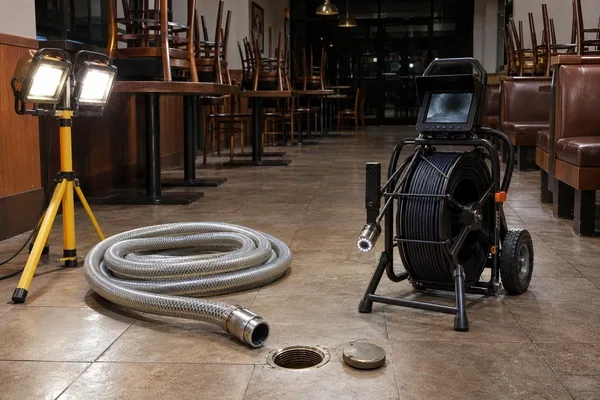
The camera runs before and after. Before shows what needs fixing, and after shows the finished pipe, with footage you keep for your records.
Before any liner is cut, we camera-inspect the line. The inspection looks for root intrusion, bellies, cracks and breaks, offset joints, and grease and scale buildup. You can watch the monitor live and get a written report with photos.
We inspect before jetting, too, because jetting a collapsing clay line can make it worse. After lining, a post-lining inspection checks the result, and you receive footage of the finished pipe.
Sometimes the camera changes the plan. On one Orlando sewer camera job at a home, the crew found a dense root mass about 22 feet down the line. After hydro jetting, a second inspection showed the pipe clear and structurally sound, so lining was not needed right away. Call (321) 363-1995 or contact us to schedule an inspection.